
A Reflection from Comparative Reasoning
Virtue, Flourishing, and the Scandal of Weakness
Aristotle and Jesus both care deeply about the good life.
They both ask what kind of person one must become in order to live well, and neither is satisfied with mere rule-following or surface-level morality. But despite this shared concern, their visions of human flourishing pull in strikingly different directions.
On one side stands Aristotle, architect of virtue ethics, who argues that excellence is cultivated through disciplined habit, rational judgment, and the steady formation of character. On the other stand the Beatitudes, where Jesus pronounces blessing not on the strong, the capable, or the well-trained—but on the poor in spirit, the meek, the mourners, and the persecuted.
Put together, they force an uncomfortable question:
What counts as flourishing?
Aristotle: Virtue as Excellence Through Practice
For Aristotle, virtue is not a feeling or a belief. It is a capacity—a stable disposition formed by repeated action. You become just by doing just acts. You become courageous by practicing courage. Over time, the soul learns to desire what reason identifies as good.
Flourishing (eudaimonia) is the natural result of this process. It is not luck, grace, or divine interruption, but the culmination of a life well-trained—one in harmony with reason, proportion, and purpose (telos).
In this vision, weakness is not virtuous. It is a deficiency to be corrected. Excess and deficiency alike miss the mark. The good life is balanced, measured, and intelligible.
Aristotle’s moral world makes sense. It rewards effort. It scales with discipline. And it resonates deeply with how most of us already think improvement works.
Which is precisely why the Beatitudes feel so strange.
The Beatitudes: Blessed Are the Unimpressive
The Beatitudes do not describe virtues that can be cleanly practiced into existence.
They name conditions that look more like failures than excellences.
- Poverty of spirit
- Mourning
- Meekness
- Hunger rather than fullness
- Mercy rather than control
- Persecution rather than success
These are not habits one can easily cultivate. In many cases, they are circumstances one endures rather than achieves.
And yet, Jesus calls these states blessed.
Not as stepping stones to something better—but as places where the Kingdom of God is already present.
This is not a different method for achieving the same goal. It is a redefinition of the goal itself.
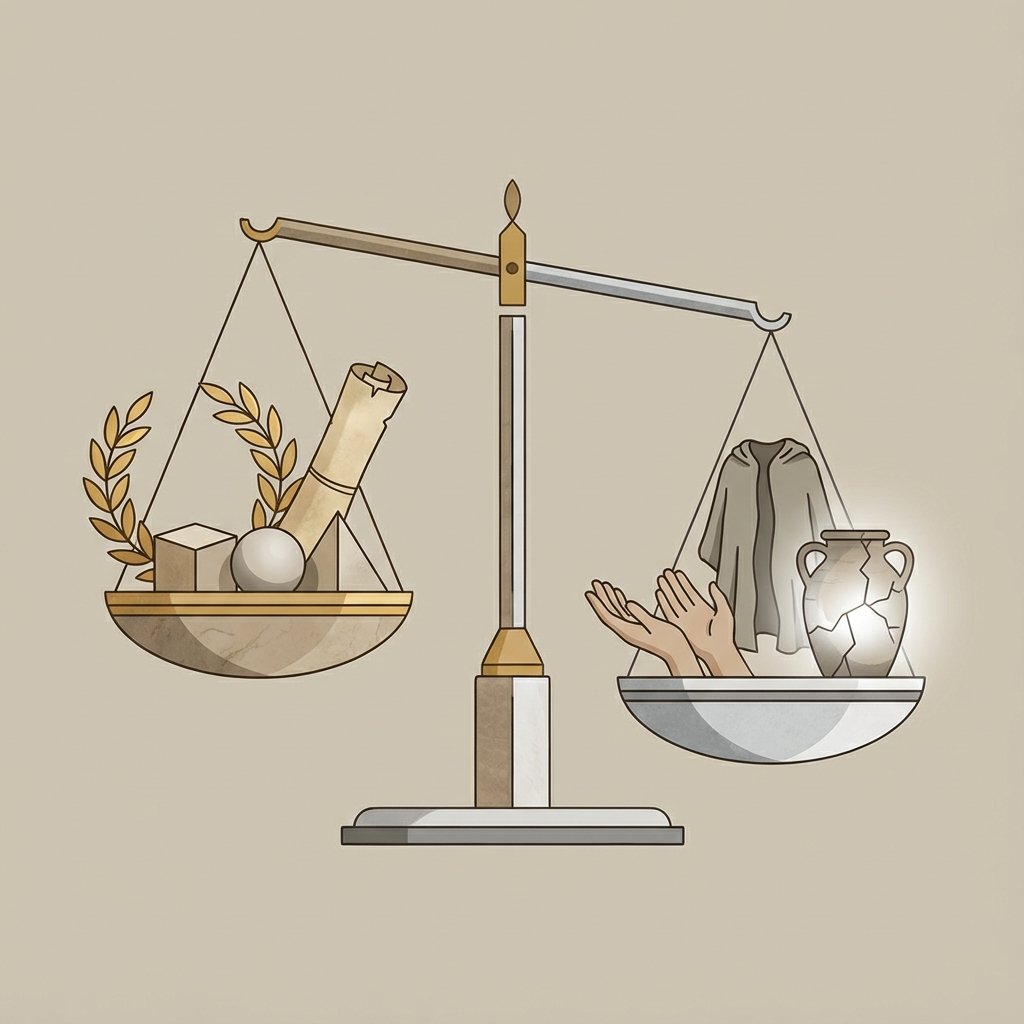
Practice or Grace?
Here the tension sharpens.
Aristotle assumes that moral excellence must be earned through repetition and rational self-mastery. The Beatitudes suggest that moral worth can precede competence—and may even appear where competence has failed.
So which is it?
Is virtue something we build through discipline, or something we receive through grace?
The discomfort here is intentional. The Beatitudes do not abolish moral effort, but they refuse to make effort the gatekeeper of worth. They interrupt the assumption that flourishing is always visible, admirable, or socially legible.
They ask whether goodness might exist before strength—rather than after it.
Can Weakness Be a Moral Good?
Aristotle would likely say no. Weakness, for him, signals a lack of proper formation. It is not something to praise, but something to remedy.
The Beatitudes insist otherwise.
They suggest that certain forms of weakness—when honestly borne rather than denied—can become sites of truth, dependence, and transformation. Not because weakness is impressive, but because it unmasks illusions of self-sufficiency.
In this light, meekness is not passivity. Mourning is not despair. Poverty of spirit is not self-contempt.
They are postures that refuse to pretend we are complete on our own.
Two Visions of the Good Life
Aristotle gives us a world where flourishing is intelligible, teachable, and achievable through formation.
The Beatitudes give us a world where flourishing may arrive disguised as loss—and where blessing does not wait for mastery.
Neither vision is shallow. Neither can be collapsed into the other.
Together, they force us to ask a question no ethical system can avoid:
Is the good life something we perfect—or something that finds us when perfection fails?
The tension remains unresolved.
And that, according to TheologicMethod, is exactly where thinking should begin.
Discover through AI
Virtue vs Blessing: The Beatitudes × Aristotle Lab
A guided, witty comparison of two visions of “the good life.”
Aristotle and the Beatitudes offer two powerful—but sharply different—visions of the good life. Aristotle understands virtue as excellence formed through habit, discipline, and practical wisdom, culminating in human flourishing (eudaimonia). The Beatitudes, by contrast, pronounce blessing on states that appear weak, costly, or inverted: poverty of spirit, meekness, mourning, and mercy. Put side by side, they raise a deeper question than mere moral technique—what counts as flourishing in the first place?
This comparison explores whether virtue is something achieved through practice or received through grace, and whether weakness can ever be a genuine moral good rather than a failure to be overcome. Aristotle’s vision rewards formation, balance, and rational mastery; the Beatitudes disrupt those expectations by locating blessing where mastery falters. Neither collapses easily into the other.
Rather than resolving the tension, this pairing invites the reader to sit inside it. What kind of life are we aiming for—and what happens when excellence and blessing point in different directions?