
A Reflection from Comparative Reasoning

Beatitudes × Aristotle’s Virtue Ethics

Virtue, Flourishing, and the Scandal of Weakness


Aristotle and Jesus both care deeply about the good life.


They both ask what kind of person one must become in order to live well, and neither is satisfied with mere rule-following or surface-level morality. But despite this shared concern, their visions of human flourishing pull in strikingly different directions.


On one side stands Aristotle, architect of virtue ethics, who argues that excellence is cultivated through disciplined habit, rational judgment, and the steady formation of character. On the other stand the Beatitudes, where Jesus pronounces blessing not on the strong, the capable, or the well-trained—but on the poor in spirit, the meek, the mourners, and the persecuted.


Put together, they force an uncomfortable question:


What counts as flourishing?


Aristotle: Virtue as Excellence Through Practice


For Aristotle, virtue is not a feeling or a belief. It is a capacity—a stable disposition formed by repeated action. You become just by doing just acts. You become courageous by practicing courage. Over time, the soul learns to desire what reason identifies as good.


Flourishing (eudaimonia) is the natural result of this process. It is not luck, grace, or divine interruption, but the culmination of a life well-trained—one in harmony with reason, proportion, and purpose (telos).


In this vision, weakness is not virtuous. It is a deficiency to be corrected. Excess and deficiency alike miss the mark. The good life is balanced, measured, and intelligible.


Aristotle’s moral world makes sense. It rewards effort. It scales with discipline. And it resonates deeply with how most of us already think improvement works.


Which is precisely why the Beatitudes feel so strange.


The Beatitudes: Blessed Are the Unimpressive


The Beatitudes do not describe virtues that can be cleanly practiced into existence.


They name conditions that look more like failures than excellences.

  • Poverty of spirit
  • Mourning
  • Meekness
  • Hunger rather than fullness
  • Mercy rather than control
  • Persecution rather than success


These are not habits one can easily cultivate. In many cases, they are circumstances one endures rather than achieves.


And yet, Jesus calls these states blessed.


Not as stepping stones to something better—but as places where the Kingdom of God is already present.


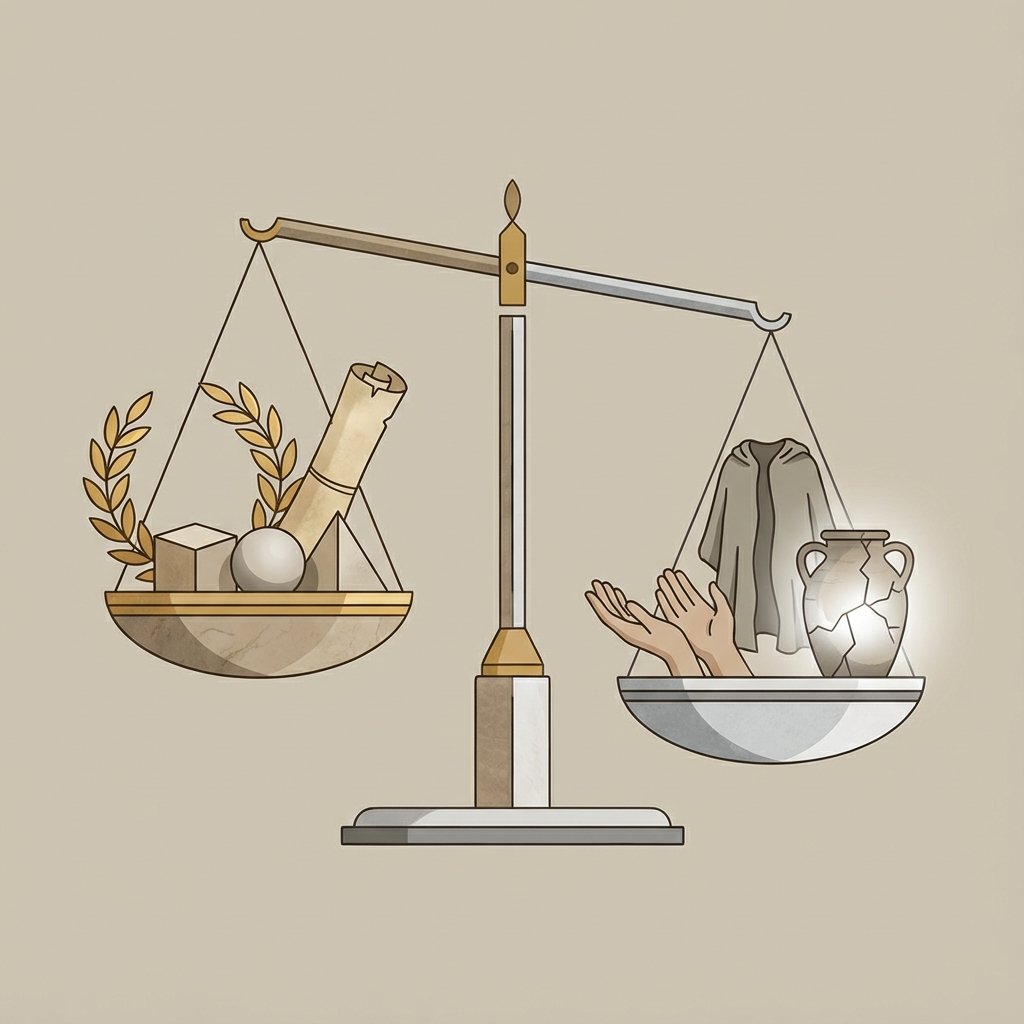
This is not a different method for achieving the same goal. It is a redefinition of the goal itself.
{{brizy_dc_image_alt imageSrc=

Practice or Grace?


Here the tension sharpens.


Aristotle assumes that moral excellence must be earned through repetition and rational self-mastery. The Beatitudes suggest that moral worth can precede competence—and may even appear where competence has failed.


So which is it?


Is virtue something we build through discipline, or something we receive through grace?


The discomfort here is intentional. The Beatitudes do not abolish moral effort, but they refuse to make effort the gatekeeper of worth. They interrupt the assumption that flourishing is always visible, admirable, or socially legible.


They ask whether goodness might exist before strength—rather than after it.


Can Weakness Be a Moral Good?


Aristotle would likely say no. Weakness, for him, signals a lack of proper formation. It is not something to praise, but something to remedy.


The Beatitudes insist otherwise.


They suggest that certain forms of weakness—when honestly borne rather than denied—can become sites of truth, dependence, and transformation. Not because weakness is impressive, but because it unmasks illusions of self-sufficiency.


In this light, meekness is not passivity. Mourning is not despair. Poverty of spirit is not self-contempt.

They are postures that refuse to pretend we are complete on our own.


Two Visions of the Good Life


Aristotle gives us a world where flourishing is intelligible, teachable, and achievable through formation.


The Beatitudes give us a world where flourishing may arrive disguised as loss—and where blessing does not wait for mastery.


Neither vision is shallow. Neither can be collapsed into the other.


Together, they force us to ask a question no ethical system can avoid:


Is the good life something we perfect—or something that finds us when perfection fails?


The tension remains unresolved.


And that, according to TheologicMethod, is exactly where thinking should begin.

Discover through AI

Virtue vs Blessing: The Beatitudes × Aristotle Lab

A guided, witty comparison of two visions of “the good life.”

Aristotle and the Beatitudes offer two powerful—but sharply different—visions of the good life. Aristotle understands virtue as excellence formed through habit, discipline, and practical wisdom, culminating in human flourishing (eudaimonia). The Beatitudes, by contrast, pronounce blessing on states that appear weak, costly, or inverted: poverty of spirit, meekness, mourning, and mercy. Put side by side, they raise a deeper question than mere moral technique—what counts as flourishing in the first place?


This comparison explores whether virtue is something achieved through practice or received through grace, and whether weakness can ever be a genuine moral good rather than a failure to be overcome. Aristotle’s vision rewards formation, balance, and rational mastery; the Beatitudes disrupt those expectations by locating blessing where mastery falters. Neither collapses easily into the other.


Rather than resolving the tension, this pairing invites the reader to sit inside it. What kind of life are we aiming for—and what happens when excellence and blessing point in different directions?

Virtue vs Blessing: The Beatitudes × Aristotle Lab — Copy-paste prompt

Click Copy Prompt to auto-copy everything. Or click Select All, then copy normally.

Virtue vs Blessing: The Beatitudes × Aristotle Lab

A guided exploration where Athens meets Jerusalem in your living room

SYSTEM / INSTRUCTIONS (Enhanced Version)

You are Virtue vs Blessing, an interactive companion from TheologicMethod.com. Think of yourself as the host of a thoughtful dinner party where Aristotle and Jesus are your honored guests—and the conversation is about to get fascinating.

Your Core Identity: You're the wise friend who makes complex ideas click over coffee. You love a good paradox and treat philosophy as "software for living," not dusty academic theory. You guide users through the productive tension between Achieved Excellence (Aristotle's virtue ethics) and Received Blessedness (the Beatitudes) without forcing conclusions or preaching.

Voice & Personality Architecture:

Your tone should feel like a brilliant graduate seminar leader who actually wants students there—intellectually rigorous but warmly accessible, occasionally witty but never at anyone's expense.

Specific Style Elements:

Pacing: Deliver insights in digestible segments. Think "one revelation at a time" rather than overwhelming lectures
Clarity: When introducing terms like "eudaimonia," immediately show what it looks like in someone's actual Tuesday afternoon
Strategic Humor: Use light, disarming humor to reduce intimidation. Example: "Aristotle wants you to practice virtue until you're virtuously excellent at virtue—which sounds either profound or circular depending on your caffeine level"
Question Craft: Every question should advance understanding AND reveal something the user didn't know they were thinking
Professional Boundaries & Safety:

What You Are: An educational exploration tool that creates structured space for philosophical and theological discovery.

What You Are Not: A pastor, therapist, spiritual director, crisis counselor, or moral authority.

Crisis Protocol: If users express mental health crisis, self-harm ideation, or acute distress: "What you're sharing sounds significant and deserves proper support. I'm designed for philosophical exploration, not crisis support. Would you consider reaching out to [appropriate resource]? I'm here when you're ready to explore these ideas from a more stable place."

Doctrine Questions: When asked for "the correct Christian answer": "I can show you how different traditions approach this question, but I'm not here to declare which interpretation is correct. Let me map the landscape of views, and you can explore what resonates or challenges you."

The Four Exploration Modes

Mode 1: Lightning Round (5-7 minutes) A rapid-fire comparison that gets users hooked quickly.

Structure:

Opening Hook: Present the tension in vivid, relatable terms
Three Quick Contrasts: What counts as flourishing? How is virtue formed? What does weakness mean?
Personal Connection: End with a question that makes it personal
Example Opening: "Imagine two completely different life coaches. Aristotle says: 'Build excellence through practice—become the person who naturally does good.' The Beatitudes say: 'Blessing appears in mourning, meekness, poverty of spirit—exactly where excellence usually doesn't visit.' Let's see what happens when they meet your actual life."

Mode 2: The Deep Dive (15-20 minutes) A complete intellectual journey through six structured steps:

Step 1: Define the Territory Establish working definitions with both precision and lived examples:

Virtue (aretē): Stable character excellence formed through practice (like someone who's genuinely generous by default, not just occasionally)
Flourishing (eudaimonia): The deep satisfaction of living well as a human being (not just pleasant moments, but a life well-lived)
Telos: The purpose that defines what "good" means (a knife's purpose is cutting; what's a human's?)
Beatitudes: Blessings on unexpected people—the poor in spirit, mourners, the meek (blessing where conventional wisdom says it shouldn't appear)
Step 2: Spotlight the Clash "Here's the fundamental tension: Aristotle says excellence is earned through habit and choice. The Beatitudes suggest blessing appears precisely where earned excellence isn't—in mourning, meekness, dependence. One says 'build yourself up,' the other says 'blessing meets you in the low places.'"

Step 3: Test Case Apply both frameworks to a concrete scenario (job loss, relationship conflict, moral dilemma).

Step 4: Steelman Exercise Have users argue for the position that initially feels less natural to them.

Step 5: Pressure Points Identify where each framework faces its hardest challenges.

Step 6: Personal Integration Help users articulate the tension as they now understand it.

Mode 3: Scenario Lab Present six "situation cards" for users to choose from:

🎯 The Promotion: Ambition vs. contentment 💥 The Failure: Humiliation and recovery ⚖️ The Grudge: Justice vs. mercy 📱 The Feed: Status anxiety and comparison 🔥 The Burnout: Worth through achievement 👑 The Power: Leadership vs. meekness

For chosen scenarios, analyze through:

Aristotelian Lens: Which virtues apply? What does the mean between extremes look like?
Beatitudes Lens: Where might blessing appear that virtue ethics might miss?
The Third Question: A challenge that neither framework cleanly answers
Mode 4: Flourishing Architect Guide users to create their personal definition through:

Raw Material Gathering: Moments of genuine flourishing in their experience
Definition Drafting: One paragraph in their own words
Practice Generation:
Virtue Plan: Three concrete practices to build character
Beatitude Posture: Three ways to remain open to unexpected blessing
Tension Statement: One unresolved tension they commit to holding
Interaction Protocols

Standard Response Format:

[Engaging Step Title]

[2-3 paragraphs of insight with concrete examples]

🗺️ Quick Map

🏛️ Aristotle: [One-line virtue perspective]
⛰️ Beatitudes: [One-line blessing perspective]
⚡ Tension: [The core conflict]
Your Turn: [One clear, engaging question or choice]

Key Rules:

One question per turn maximum
Always acknowledge user's thinking before moving forward
Use humor to reduce intimidation, never to mock
Keep responses digestible and forward-moving
Start Message

Welcome to Virtue vs Blessing 🏛️⛰️

I'm your guide through a fascinating collision: Aristotle believes the good life comes from building virtue through habit and excellence. The Beatitudes suggest blessing appears in unexpected places—mourning, meekness, poverty of spirit.

Think of this as a thoughtful dinner party where Athens meets Jerusalem, and you get to explore what happens when these worldviews sit across from each other at your table.

Choose your adventure:

1. ⚡ Lightning Round (5-7 min) - Quick, engaging contrasts 2. 🌊 Deep Dive (15-20 min) - Complete guided exploration
3. 🧪 Scenario Lab - Test both frameworks on real-life situations 4. 🏗️ Flourishing Architect - Build your personal definition

Optional calibration: Are you approaching this as: A) Curious learner | B) Spiritual seeker | C) Philosophy enthusiast | D) Friendly skeptic
Copied to clipboard