
A Reflection from the Heart
When Shadows Meet Light
Platonic Forms and John 8: The Quest for Ultimate Reality
You’ve spent your entire life looking at shadows.
Not literal shadows—though Plato would say that’s closer to the truth than you think. The shadows are the assumptions you mistake for reality:
- “Success is defined by wealth and status”
- “Beauty is what culture says it is”
- “Truth is whatever works for me right now”
- “My identity is the sum of my achievements and failures”
These beliefs feel solid. Unchangeable. Real.
But what if they’re just reflections of something truer?
And what if the path from shadows to reality requires more than intellectual enlightenment—what if it requires a Person?
Two ancient texts offer radically different answers to humanity’s oldest question:
What is ultimately real, and how do we know it?
This essay explores both approaches—and shows you how to examine one shadow belief in your own life.
Plato’s Cave: Escape Through Philosophy
Around 380 BCE, Plato wrote the Allegory of the Cave—one of Western philosophy’s most enduring images.
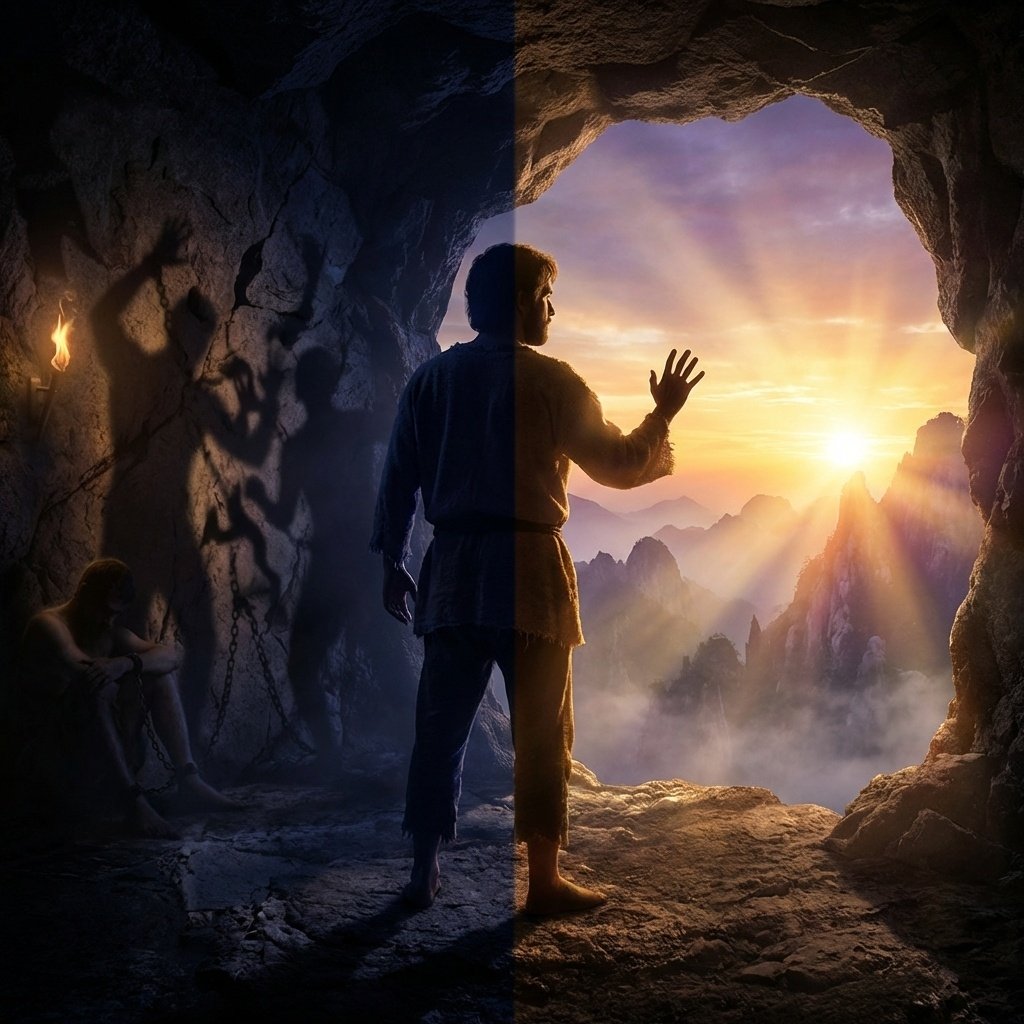
Imagine prisoners chained in a cave since childhood, facing a wall. Behind them burns a fire. Between the fire and the prisoners, people carry objects that cast shadows on the wall. The prisoners see only these shadows—and believe the flickering images are reality itself.
One prisoner is freed.
He turns around, sees the fire, and realizes the shadows were projections. Dragged up the cave’s steep passage, he emerges into sunlight and discovers the real world—trees, mountains, the sun itself. The shadows were copies of copies.
Plato’s revolutionary claim:
The physical world we perceive is like those shadows.
Ultimate reality consists of perfect, eternal Forms—the unseen templates behind everything we experience:
- Physical beauty points to the Form of Beauty
- Just actions participate in the Form of Justice
- Circular objects imitate the Form of the Circle
Daily experience is the shadow realm. Truth requires philosophical ascent—rigorous reasoning that moves the mind from appearances to eternal realities.
The Platonic Method
- Question appearances — sensory experience cannot be trusted
- Use reason to ascend — dialectic moves from physical to metaphysical
- Contemplate the Forms — intellectual vision of eternal truth
- Return to help others — the enlightened are obligated to teach
The promise: You can escape the cave through disciplined thought.
The limitation: It’s a lonely journey. The Forms are perfect—but impersonal.
John 8: Truth With a Face
Seven centuries later, in first-century Jerusalem, a confrontation unfolded that would redefine what truth means.
Jesus taught in the temple courts. Religious leaders challenged his authority. The exchange escalated until he made a claim that would have stunned any Platonist present:
“I am the light of the world. Whoever follows me will never walk in darkness, but will have the light of life.”
— Gospel of John 8:12
Later in the same discourse:
“If you hold to my teaching, you are really my disciples. Then you will know the truth, and the truth will set you free.”
— John 8:31–32
And finally, the statement that redefined Western metaphysics:
“Before Abraham was born, I am.”
— John 8:58
This wasn’t speculation about abstract Forms. This was Jesus claiming to be:
- The eternal source of truth
- The light that exposes all shadows
- The liberator who sets people free
- The personal revelation of ultimate reality
John’s claim is radical:
Ultimate reality isn’t something you contemplate—it’s Someone you encounter.
Truth doesn’t just illuminate the mind. It transforms the person. And the journey from darkness to light isn’t a solo ascent—it’s a relationship with “the light of the world.”
The Johannine Method
- Recognize your darkness — “everyone who sins is a slave” (John 8:34)
- Encounter the Light — not concepts, but a person
- Follow, don’t just study — relationship, not mere cognition
- Experience transformation — truth sets you free from the inside out
The promise: You don’t escape the cave alone—the Light enters it.
The Crucial Difference
Plato’s FormsJohn’s LightTruth is an eternal abstractionTruth is an eternal PersonAscent through reason aloneTransformation through relationshipShadows deceive—escape themShadows expose need—truth healsThe wise few can make the climbThe Light comes to all who are willingFreedom = knowledge of FormsFreedom = knowing and being known
Plato says: “The shadows are deceptive. Ascend to eternal truth.”
John says: “The shadows reveal your need. Eternal truth descended to you.”
Both agree: you’re living in shadows.
They disagree on how liberation happens—and whether truth cares about you personally.
What Both Reveal About Your Life
You probably hold beliefs that function like shadows—rarely examined, quietly powerful:
- Cultural shadows: “My worth equals my productivity”
- Relational shadows: “I must perform to be loved”
- Identity shadows: “I am what I achieve”
- Moral shadows: “Right and wrong are social constructs”
These aren’t random. They’re the shadows most people today mistake for reality.
- Platonic questioning asks: What is this a shadow of?
- Johannine encounter asks: Is this belief enslaving me?
The Integration: From Shadows to Light
Here’s how both lenses work together on one belief.
Step 1: Identify the Shadow (Platonic Analysis)
Choose one belief—for example:
“I am only valuable when I’m successful.”
Ask:
- Where did this belief come from?
- What am I mistaking for ultimate reality?
- What might the truer “Form” of value be?
Step 2: Test the Shadow’s Power (Johannine Examination)
Ask:
- Does this belief enslave me?
- What would freedom from it look like?
- Can reason alone undo its grip?
Step 3: Move Toward Light (Integration)
- Philosophical honesty: I’ve been living by a shadow.
- Theological vulnerability: What if this belief is a lie?
- Relational truth: Can I trust being known before achieving?
The synthesis:
Philosophy exposes the shadow.
Theology offers a Light that heals.
What This Method Does
This isn’t abstract philosophy or devotional cliché. It’s applied wisdom:
- Platonic Lens: Identify the shadows you live by
- Johannine Lens: Encounter truth as something personal
- Integration: Experience clarity and freedom together
Your cave.
Your shadows.
Your light.
Comparative Wisdom, Not Conversion
This is not evangelism disguised as education.
- Plato asked profound questions about reality
- John made unprecedented claims about Jesus
- Both give tools for examining your assumptions
No commitment required. Only one question:
Which of your beliefs might be a shadow?
The Question Both Teachers Ask You
Plato asks:
Are you willing to question everything you think you know?
Jesus asks:
Are you willing to follow the truth—even if it knows you completely?
The examined life requires both courage and trust.
Which shadow are you ready to examine?
Discover through AI - Newsletter #1
Socratic Self-Examination & Psalm 139: Divine Examination
This prompt defines Newsletter #1 GPT: Socratic Self-Examination & Psalm 139: Divine Examination—a specialized writing engine built to craft immersive, intellectually disciplined newsletters. It operates as a guided reading experience that stages a structured contrast between two ancient modes of self-understanding: Socrates’ rational self-examination in Athens and David’s experience of divine examination in Jerusalem. Each installment is composed to unfold gradually, drawing readers into philosophical and spiritual tension without ever resolving it.