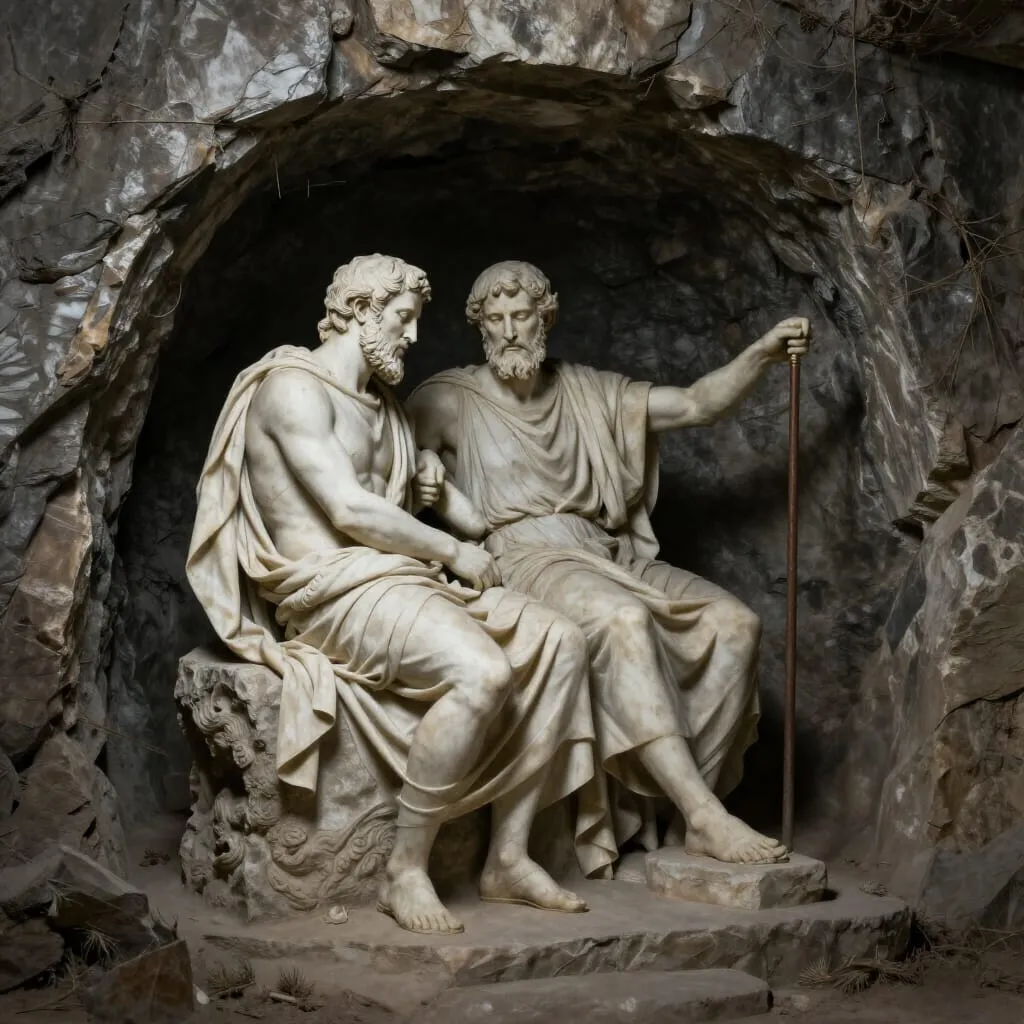
🌑 The Shadows We Live In
You once believed that success was simple mathematics: hard work + doing everything right = predictable results. Stay disciplined. Check all the boxes. Watch things fall into place.
It was a clean formula. A controllable universe. A shadow that looked so much like reality you never questioned it.
Then life happened. Setbacks arrived. The formula failed. And in that uncomfortable, humbling moment, something shifted. The shadow cracked. Light seeped through. You saw what you couldn't see before: luck, timing, emotional intelligence, relationships—forces beyond your control, woven into the fabric of everything.
You lost your illusion of total control. But you gained something else: compassion. Humility. Balance. A new appreciation for the unpredictable nature of life.
This is not just your story. It is the story.
Twenty-four centuries ago, a philosopher in Athens descended into a cave to explain why humans mistake shadows for reality. Six centuries later, a carpenter from Nazareth stood in Jerusalem and declared, "I am the light of the world."
Both Plato and Jesus recognized the same human condition: we live in darkness, mistaking what we see for what is real.
But they offered different paths to illumination. One through ascent. One through encounter.
Your moment of awakening—when success revealed itself as more complex than formulas—stands at the crossroads of both.
🏛️ Athens: Descending Into Plato's Cave
Picture this:
Deep underground, prisoners sit chained in place since childhood. They face a wall. Behind them burns a fire. Between the fire and the prisoners, people carry objects—puppets, vessels, statues—casting shadows on the wall.
The prisoners see only the shadows. They hear only echoes. And because they've never seen anything else, they believe the shadows are reality. They name them. Argue about them. Build entire systems of knowledge around flickering projections.
This is Plato's Allegory of the Cave—one of the most famous images in Western philosophy, found in his dialogue The Republic.
Now imagine one prisoner is freed. Dragged upward. At first, the firelight burns his eyes. He resists. He wants to return to the familiar darkness.
But he's pulled further—out of the cave entirely, into sunlight. The pain intensifies. He can barely see. Everything he thought was real now seems like a cheap imitation.
Slowly, his eyes adjust. He sees trees. Mountains. The sky. Eventually, he looks at the sun itself—the source of all light and life, what Plato calls the Form of the Good.
This is philosophical awakening. The painful recognition that what you thought was real was only a projection. The difficult climb toward truth.
But here's where it gets harder: the freed prisoner returns to the cave. He tries to tell the others what he's seen. They think he's lost his mind. They mock him. In Plato's telling, they would kill him if they could.
Why? Because truth threatens the comfortable lies we've built our lives around.
Does this resonate with your story? You lived in a kind of cave—the cave of meritocracy, where effort equaled outcome, where control was possible. Then something dragged you upward. At first, it hurt. You resisted. But slowly, you adjusted to a more complex light: the reality of luck, timing, interdependence.
You couldn't go back to the old formula. You'd seen too much.
✝️ Jerusalem: The Light That Descends
Now shift the scene forward six centuries and east to Jerusalem.
It's the Feast of Tabernacles—a festival where massive lampstands are lit in the temple courts, illuminating the city. Into this setting, Jesus makes a staggering claim:
—John 8:12
This is not metaphor. This is not philosophy. This is identity.
Where Plato described a sun outside the cave—something to be reached through intellectual ascent—Jesus claims to be the light. And not a distant light requiring years of philosophical training to perceive. A light that enters the cave.
In the Gospel of John, written in a world saturated with Greek philosophy, light and darkness carry cosmic weight:
Darkness = separation from God, moral confusion, spiritual blindness, death.
Light = divine presence, truth revealed, life itself.
The staggering claim of Christianity is this: you don't have to ascend to find the light. The light descended to find you.
Consider the story of the man born blind in John 9. He didn't climb out of darkness through philosophy or moral improvement. Jesus found him. Touched him. And suddenly, the man who had never seen anything saw everything.
The religious leaders—those who thought they had the light—rejected him. They preferred their controlled system, their theological formulas, their shadows of righteousness.
Jesus tells them: "For judgment I have come into this world, so that the blind will see and those who see will become blind."
Translation: real illumination begins when you admit you're in darkness.
Does this speak to your experience? You didn't climb to a new understanding through pure discipline. Life broke your formula. Grace arrived in the form of failure. Humility became a door. You let go of control and found something more real: compassion, balance, appreciation for what you cannot engineer.
You were found in your darkness.
⚖️ Two Paths to Illumination
🏛️ The Platonic Path
Ascent Through Effort
Truth exists outside the cave. You must climb toward it through reason, discipline, and philosophical training. The journey is painful. Most won't make it. But those who do bear responsibility to return and help others.
Light is the goal. Darkness is where you start.
✝️ The Johannine Path
Descent Through Grace
Light enters the darkness. Truth comes to you, not because you're ready, but because you need it. The light is a person. Following Him changes not just what you know, but who you are. Illumination is encounter, not achievement.
Light is the gift. Darkness is where He finds you.
These are not contradictions. They are complementary revelations about how truth works:
Plato is right: You must leave the cave. You must endure the pain of seeing your illusions shatter. You must develop eyes capable of seeing.
Jesus is right: You can't do it alone. The light must meet you. Grace must break your self-sufficiency. Truth is relational, not just intellectual.
Look at your own story through both lenses:
Did truth require your ascent? Yes—you had to go through setbacks, recognize your limits, develop new emotional and relational intelligence.
Did truth arrive unexpectedly? Yes—you didn't plan to lose control. Life humbled you. Grace arrived through failure, not formulas.
Perhaps illumination requires both: the willingness to climb and the humility to receive.
🔬 The Light Laboratory
Interactive Practice: Identifying Your Shadows
It's time to get practical. Let's identify the shadows you're still living with—and apply both Platonic and Johannine lenses.
Think of something you currently believe to be true that might actually be a projection—a simplified version of reality you've mistaken for the whole picture.
Examples: "My worth depends on my productivity." "If I'm vulnerable, people will see me as weak." "Success means financial security."
Ask yourself: What would it take for me to "leave the cave" on this belief?
What would I need to study, question, or experience to see a truer version of reality? What intellectual or philosophical work is required?
Ask yourself: What if the truth on this came to me, rather than me achieving it?
What would it mean if grace, relationship, or love revealed what I couldn't see on my own? Where is light already trying to enter my darkness?
Write one sentence that holds both paths in tension:
"I am working to understand __________, but I am also open to being found by __________."
📱 Modern Illuminations
Let's bring this into the 21st century. What are the caves we live in now? What are today's shadows?
📺 Media & Misinformation
We watch curated feeds and algorithmic projections. We mistake engagement for truth. We argue about shadows on screens, rarely asking what's casting them.
🎓 Education as Achievement
We measure learning by credentials and test scores—shadows of knowledge. Real illumination is transformation, not accumulation.
🔬 Scientific Certainty
Science reveals reality—but scientism mistakes models for the thing itself. Maps are not territories. Equations are not the sun.
💼 Success as Status
Your old formula: work hard, do right, succeed. But success-as-shadow hides the deeper question: What is a life well-lived?
😌 Spiritual Bypass
Even faith can become a shadow—rituals without transformation, beliefs without encounter, light-language without actual illumination.
👥 Identity as Performance
Social media projects versions of ourselves. We curate shadows. We forget who we are in the light.
In each case, both Plato and Jesus ask the same foundational question:
"What counts as real?"
Plato answers: Reality is what remains when you strip away appearances, opinions, and projections.
Jesus answers: Reality is found in relationship with the source of all light—the one who says, "I am."
🚶 The Vision Journey
Close your eyes for a moment. Imagine this:
You're sitting in a dimly lit room. Not uncomfortable—just... limited. There's a window, but it's covered. You've been here so long you've stopped wondering what's outside.
You've built a good life in this room. You've learned the rules. You know how to navigate the furniture in the dark. You've even taught others your system: work hard, move carefully, control what you can.
Then one day, something breaks. Maybe it's a failure. Maybe it's a loss. Maybe it's just exhaustion. But the thing you were holding—the formula, the control, the certainty—slips from your hands.
And in that moment of loss, someone pulls back the curtain.
The light floods in. It's overwhelming. You squint. You want to look away. Everything you thought was solid now looks like shadow. Everything you trusted feels flimsy.
But you don't close your eyes. You let them adjust.
Slowly, you see: the room was never the whole house. The rules you learned were real—but incomplete. The work you did mattered—but it was never the whole story.
You see other people now, not as competitors in your system, but as fellow travelers. You see timing, chance, grace—things you couldn't control, woven into everything.
You feel something unexpected: relief. You don't have to be the light. You just have to stop blocking it.
This is the journey. Not from darkness to a blinding flash that solves everything. But from shadow to nuance. From control to trust. From formulas to wisdom.
Plato would say: "You've begun the ascent. Keep climbing."
Jesus would say: "You've been found. Keep following."
Both are true.
🔮 Seeing Further
We don't end with answers. We end with vision—the capacity to see more than we did before.
Take these questions with you:
- What shadow are you still defending as reality—because letting it go would require too much change?
- Where in your life is truth requiring ascent (your effort, discipline, questioning)—and where is it offering descent (grace, encounter, something beyond your control)?
- If someone who loved you could see your life from outside your cave, what would they say you're missing?
- What would it mean to live as someone who has "seen the sun"—but must still navigate a world of shadows?
- Are you more afraid of being wrong—or of being unable to change when you see the truth?
- If Jesus is light and Plato describes the journey toward it, what does it mean that the light has a face?
You are no longer in complete darkness.
You are no longer in blinding light.
You are in the space between—
where sight is possible,
where shadows reveal their source,
where illumination becomes a way of life.
Welcome to the journey.
The cave is behind you.
The light is ahead.
Keep walking.