
A Reflection from the Heart
Why Plato and John's Gospel might be the clarity hack you've been looking for
"Anyone who has common sense will remember that the bewilderments of the eyes are of two kinds… when they have come out of the light or when they have come out of the darkness." —Plato, Republic VII
You know that feeling when you step outside after a movie and the daylight hits wrong?
Your eyes rebel. Everything's too bright, too sharp. You're temporarily blind not because there's no light, but because there's suddenly too much of it.
Our inner lives work exactly like this.
You're scrolling through career advice at 11 PM, and every article contradicts the last one. You're trying to figure out if that relationship conversation is worth having, but your thoughts keep looping. You sense something's off about how you're seeing your situation, but you can't quite put your finger on what.
Here's the quiet anxiety underneath: Am I supposed to think my way out of this confusion, or is there some kind of clarity that's supposed to find me?
Two ancient voices give you radically different answers. Put them together, and you get something surprisingly practical for your actual decisions this week.
The Question That Changes Everything
Plato's Cave story haunts people for a reason.
Picture this: you're chained in a dark cavern, facing a wall. Behind you, puppeteers cast shadows on that wall—and you mistake those shadows for reality because it's all you've ever known.
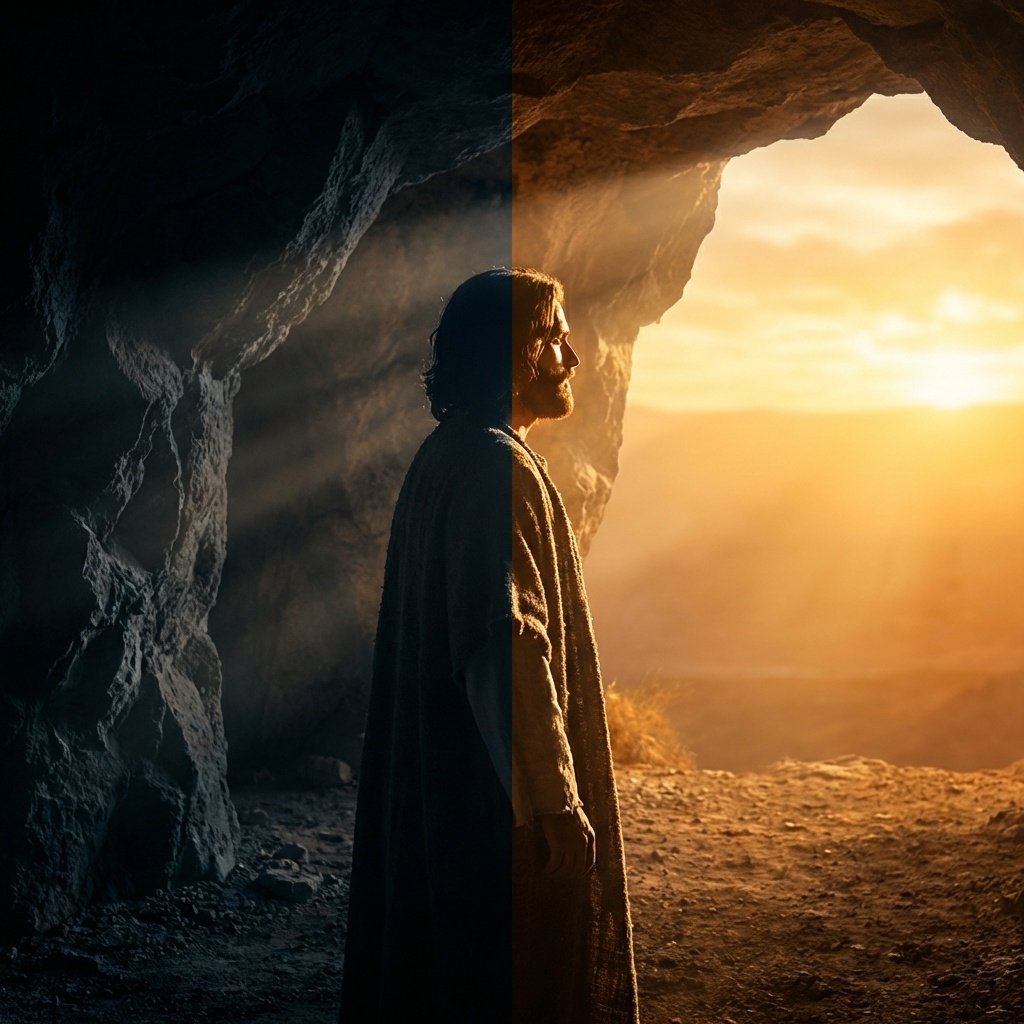
Then someone frees you. You turn around, stumble toward light, and eventually emerge into full sun. At first, the brightness hurts. Your eyes are "bewildered." But slowly, you learn to see actual things instead of their projections.
For Plato, real education isn't downloading information. It's turning your whole soul around.
But here's what Plato doesn't quite resolve: Can human reason alone make the full journey from confusion to clarity? Or do we need something like a light source—something that doesn't just reveal truth to us, but heals our capacity to see it?
Plato points toward the sun. He doesn't tell you whether it comes looking for you.
"I Am the Light of the World"
Four centuries later, in occupied Jerusalem, you get a completely different kind of claim:
"I am the light of the world. Whoever follows me will not walk in darkness, but will have the light of life."—John 8:12
This isn't a philosopher saying "Think harder until you reach the truth."
It's someone saying "Light isn't just out there waiting for the smartest people to find it. It's here. It's active. It's looking for you."
In John's world, "darkness" isn't just ignorance. It's estrangement, fear, shame, the feeling that if anyone really saw you clearly, they'd walk away.
So instead of ascent through effort, you get illumination through encounter.
Truth doesn't wait for you to be clever enough to reach it. It steps into your cave.
This is the crucial difference: Plato trains your eye to see. John says the Light is already looking for your eye.
The Scripts Running in Your Head
Most of us carry unexamined beliefs about how knowing works. They feel like facts, but they're actually inherited assumptions:
- "If I just collect enough data, I'll be certain"
- "Emotions only cloud judgment; they can't help me see clearly"
- "Truth exists independently of my personal needs"
- "If I feel exposed, I must be in danger"
- "Changing my mind proves I was wrong before"
- "The right insight will automatically change my behavior"
These beliefs silently shape how you approach every significant choice. They determine whether learning feels like threat or invitation.
The problem? If truth is only abstract information, it never gets permission to touch your shame, your grief, or your deepest longings. You can analyze your life forever without ever actually changing it.
Two Ways of Seeing, One Complete Method
What if you used both traditions together? Not as competing worldviews, but as complementary tools for real decisions?
Think of it as training your eye (Plato) while letting yourself be seen (John).
From Plato: The Discipline of Questions
- Your default perceptions are unreliable without rigorous questioning
- Growth means turning away from comfortable assumptions toward what's more real
- There's always a "Good" at stake—what would make this situation more intelligible and humane?
From John: The Grace of Being Known
- Clarity comes through relationship, not just analysis
- Truth exposes and heals simultaneously
- Being "seen" by light that doesn't condemn opens possibilities you couldn't access alone
Put simply: Plato says examine your shadows. John says let the light examine you.
The Two-Step Practice (Try This Week)
Pick one real decision you're facing. Nothing abstract—a career move, a difficult conversation, a moral complexity you keep postponing.
Step 1: Cave Questions (5 minutes)
Grab a piece of paper. Write "SHADOWS" at the top.
- What assumptions am I treating as unquestionable facts?
- What external pressures (social media, family expectations, financial fears) are distorting my view?
- What incentives am I following that might not serve the actual good here?
For each shadow, write one counter-question: "Is this always true?" or "Who benefits if I keep believing this?"
Step 2: Light Questions (5 minutes of quiet)
Put the pen down. No phone, no input.
Write "LIGHT" at the top of a new section.
Ask: "If truth arrived right now as light, what would it illuminate in me?"
Notice what comes up:
- Fear you've been avoiding?
- Defensiveness you didn't realize was there?
- A hope you've been afraid to acknowledge?
- One step that feels both honest and kind?
The Synthesis
Circle the one insight that survives both Plato's scrutiny (it holds up under questioning) and John's illumination (it feels true when you're willing to be seen).
Translate that into one concrete action you can take within 48 hours.
Why This Actually Matters
We live in a culture that pulls us toward two broken extremes:
Cold analysis without transformation (facts that never touch your heart) or warm feelings without discernment (comfort that protects your illusions).
Plato without John leaves you with abstractions that never heal your actual wounds. John without rigorous thinking leaves you vulnerable to wishful thinking.
Together, they offer something better: a mind rigorously honest about its shadows, and a heart willing to be seen by light that doesn't shame.
You become someone who doesn't just "have opinions," but is actually being educated—turned—by reality itself.
Standing at the Mouth
Right now, you might be deep in the cave, staring at familiar shadows: productivity metrics, social approval, other people's expectations. It feels safer not to turn.
Or maybe you're already stumbling toward the entrance, half-blinded by clarity that hurts more than your old confusion.
Or perhaps you're standing right at the threshold: cave behind you, light ahead, the path uneven but real.
You don't have to see everything at once. You just need to take the next step.
Try the two-step practice this week with one actual decision. Then come back and tell us what happened. What shadows did you discover? What did the light reveal?
The comment section is your laboratory. Your experiments with ancient wisdom in modern life might be exactly what someone else needs to hear.
What's one decision you could run through this process this week?
Discover through AI - Encounter #2